Why there are Amazon links here: Brave Review is paid a commission for qualifying Amazon purchases made through the links below. Your price does not change, and using our links is entirely optional. How this works
Best Thermostat for a Bathroom Floor: 5 Picks for Warm Tile
A thermostat for a bathroom floor is a small purchase with an outsized effect on daily comfort — cold tile in the morning is the single most common complaint about heated bathroom floors, and the controller is what fixes it. This guide covers five radiant floor thermostats that suit three kinds of buyers: the budget-minded remodeler who just wants reliable warmth, the homeowner who wants app control and energy data, and the safety-focused installer who will not compromise on GFCI protection. Every pick below uses a floor sensor, so the tile itself is measured rather than the air above it. The overview table is the fast path; the reviews explain the differences.
Overview of the Picks
| Product | Key Spec | Best Use | Price Tier |
|---|---|---|---|
| Programmable Thermostat for House Radiant Underfloor Heating | Dual sensing, built-in Class A GFCI, 3600W | Budget remodel with a large mat | Budget |
| SunTouch SunStat CommandPlus Wi-Fi | 4.3" touchscreen, 7-day schedule, app access | App control and energy tracking | Premium |
| Honeywell TH115-AF-GA/U | Programmable, floor sensor, GFCI, 120/240V | Brand-name reliability, simple setup | Mid-range |
| OJ Microline UDG4 | Touchscreen, dual sensing, Class A GFCI, 3-year warranty | Warranty coverage and US support | Mid-range |
| Dual Voltage 120V/240V WiFi Heated Radiant Floor Thermostat | Touchscreen LED, Wi-Fi, dual voltage | Tight budgets that still want Wi-Fi | Budget |
1. Programmable Thermostat for House Radiant Underfloor Heating

Type: Programmable radiant floor controller
Sensing: Dual — air and floor sensor
Safety: Built-in Class A GFCI
Voltage: 120/240V AC
Power: 3600W
Programmable Thermostat for House Radiant Underfloor Heating is the value play of the group. The dual-sensing design reads both the floor and the room air, which matters in a bathroom where a warm floor and a warm room are two different goals. The built-in Class A GFCI is the headline feature at this price — it puts ground-fault protection right at the thermostat instead of relying on a separate breaker, which simplifies the wiring plan. The self-adaption voltage handling covers both 120V and 240V circuits, so the same unit works whether the mat is a small remodel add-on or a larger installation.
This pick suits the remodeler who is rewiring a single bathroom and wants one box that handles protection, scheduling and sensing. It earned its place because the feature set reads like a mid-range unit while the price sits at the bottom. The caution is straightforward: at 3600W it is generous for a bathroom, but the interface on budget units of this type is typically a button-and-display affair rather than a touchscreen, so expect a learning curve on programming.
Trade-off: The lower price is reflected in a plainer control interface and less polished documentation than the brand-name alternatives.
2. SunTouch SunStat CommandPlus Wi-Fi Thermostat

Type: Wi-Fi programmable floor thermostat
Display: 4.3-inch touchscreen
Scheduling: 7-day
Sensing: Floor and air
Extras: Energy monitor, remote app access
Installation: Easy-install design
SunTouch SunStat CommandPlus Wi-Fi Thermostat for Floor Heating is the premium pick and the most feature-dense unit here. The 4.3-inch touchscreen is large enough to read at a glance and to program without squinting, and the 7-day schedule allows a different routine for weekdays and weekends — useful in a bathroom that is busy on workday mornings and quiet on Sundays. The energy monitor is the differentiator: it lets a household see what the floor heating actually costs rather than guessing. Remote access from the app means the floor can be warmed before arrival or turned down after leaving.
This one suits the buyer who wants the bathroom to feel modern and who is comfortable with a phone-based setup. It is also the right choice for anyone who has been surprised by a utility bill and wants visibility into consumption. The drawback is proportional to the feature list: this is the most expensive pick, and the Wi-Fi and app layer adds setup steps that a plain programmable unit avoids.
Trade-off: The premium price and app-dependent setup make it overkill for a small bathroom that only needs a simple daily warm-up.
3. Honeywell TH115-AF-GA/U Radiant Heating Thermostat

Type: Programmable radiant heating thermostat
Voltage: 120/240V
Sensing: Floor sensor included
Safety: GFCI
Scheduling: Programmable
Honeywell TH115-AF-GA/U Radiant Heating 120/240V Programmable Thermostat is the known-name option, and for many buyers that is the whole argument. Honeywell is a fixture in HVAC controls, so the programming logic and the manual will feel familiar to anyone who has installed a thermostat before. The floor sensor is included rather than sold separately, and the GFCI is built in, which keeps the electrical plan simple. It handles both 120V and 240V circuits and is programmable, covering the core needs of a bathroom floor without extra layers.
This pick suits the homeowner who values a recognizable brand and predictable behavior over app features, and the installer who wants a unit with widely understood documentation. It earned its place on reliability and simplicity rather than novelty. The caution is that this is a workhorse, not a smart thermostat — there is no Wi-Fi or remote access here, so scheduling happens at the wall.
Trade-off: No app control or energy monitoring, which puts it behind the premium pick for anyone who wants remote management.
4. OJ Microline UDG4 Touchscreen Thermostat

Type: Touchscreen programmable heated floor thermostat
Sensing: Dual — air and floor
Safety: Class A GFCI
Voltage: 120/240V
Included: Floor sensor
Warranty: 3-year, with USA product support
OJ Microline UDG4 Touchscreen Programmable Heated Floor Thermostat sits in the sweet spot between the budget units and the premium SunTouch. The touchscreen brings the interface up to date, dual sensing keeps both floor and air temperature in view, and the Class A GFCI is present as it should be. The floor sensor ships in the box. What separates this pick is the support package: a 3-year warranty backed by USA product support is meaningful for a device that lives in a wet room and is wired into the wall.
This one suits buyers who want touchscreen convenience without paying for Wi-Fi, and anyone who has been burned by no-name electronics and wants a warranty with a phone number behind it. It earned its place on the combination of dual sensing, GFCI and real support coverage at a mid-range price. The caution is that the touchscreen and warranty come at a cost premium over the budget pick, and there is no app layer for remote control.
Trade-off: Buyers pay mid-range money for build quality and support rather than connectivity, so it will not satisfy anyone set on phone control.
5. Dual Voltage 120V/240V WiFi Heated Radiant Floor Thermostat
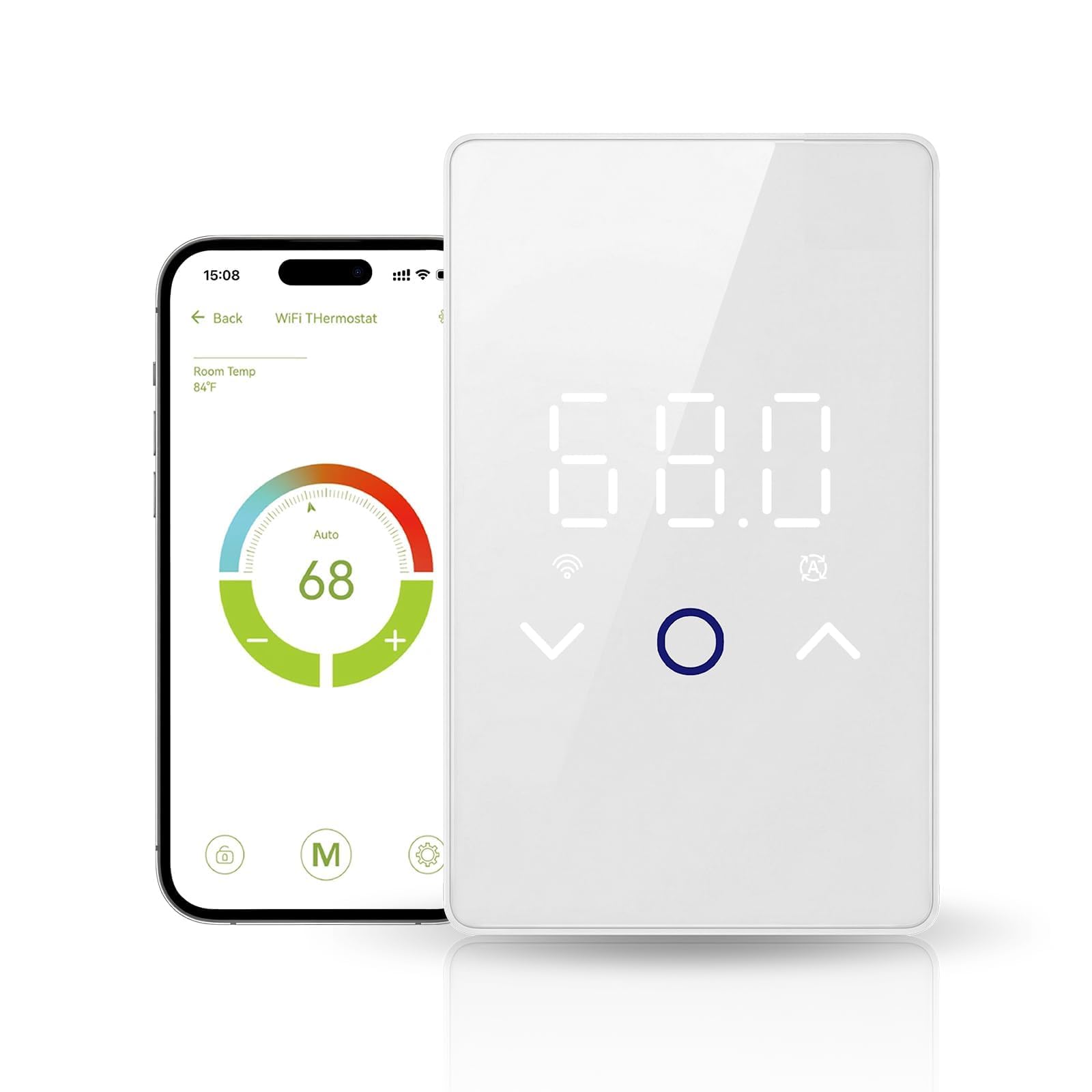
Type: Wi-Fi programmable radiant floor thermostat
Display: Touchscreen LED
Control: Remote control included
Voltage: 120V/240V dual voltage
Features: Energy saving modes, easy connection
Dual Voltage 120V/240V WiFi Heated Radiant Floor Thermostat is the budget route to Wi-Fi. The touchscreen LED display and dual-voltage handling cover the basics, and the Wi-Fi connection plus the included remote control give a household two ways to adjust the floor without touching the wall unit. Energy-saving modes are present for buyers who want the schedule to do the work. For a small bathroom floor, the feature list is more than sufficient.
This pick suits the cost-conscious buyer who still wants phone control — a combination that usually costs considerably more. It earned its place as the cheapest way into app-connected floor heating in this lineup. The caution is one of maturity: this is the least-established product here, so buyers should expect simpler documentation and a more basic app experience than the premium pick offers.
Trade-off: The aggressive price points to a lighter-duty build and a thinner support footprint than the brand-name competitors.
Before You Buy
- GFCI protection: A bathroom floor is a wet location. Confirm the thermostat has built-in Class A GFCI or that the circuit is protected upstream — every pick here lists GFCI, and that should be non-negotiable.
- Voltage match: Check whether the existing floor mat is 120V or 240V before ordering. Dual-voltage units cover both, but a single-voltage mat paired with the wrong controller is a return.
- Sensor type: Floor-only sensing protects the tile; dual sensing also watches room air. Bathrooms with strong ventilation usually benefit from dual sensing.
- Wattage headroom: Match the thermostat’s rated power to the mat’s draw with some margin. Oversized mats on an undersized controller are a common installation mistake.
- Scheduling needs: A 7-day schedule suits households with different weekday and weekend routines. A simple programmable unit is enough for a bathroom used on a fixed timetable.
- Connectivity: Wi-Fi and app control add convenience and setup complexity in equal measure. Decide whether remote access is genuinely useful before paying for it.
- Support and warranty: For a device wired permanently into a wall in a wet room, warranty length and reachable product support carry real value.
Frequently Asked Questions
-
Does a bathroom floor thermostat need a floor sensor?
Yes. A floor sensor measures the tile temperature directly, which is what prevents both cold floors and overheating. Every thermostat in this guide includes or supports one. -
Is built-in GFCI required for a heated bathroom floor?
Ground-fault protection is expected in wet locations. A thermostat with built-in Class A GFCI simplifies the installation and keeps protection local to the circuit. -
Can a 120V mat be used with a 240V thermostat?
Only if the thermostat is dual-voltage rated. Several picks here handle both 120V and 240V, but the mat’s own voltage rating must match the supply. -
Is Wi-Fi worth it for a bathroom floor thermostat?
It depends on the household. Remote access helps when schedules vary or when a homeowner wants to warm the floor before arriving; a plain programmable unit covers a fixed routine for less money. -
How much power does a bathroom floor thermostat need to handle?
Match the thermostat’s wattage rating to the mat’s draw with headroom to spare. Bathroom mats are usually modest, but the rating should still exceed the connected load. -
Can a homeowner install one of these?
Installation involves mains wiring in a wet location. A qualified electrician is the safer route, and the warranty and support terms on the mid-range picks are worth checking before any DIY attempt.
Bottom Line
For most bathrooms, the SunTouch SunStat CommandPlus Wi-Fi Thermostat is the pick that covers the most ground: a large touchscreen, 7-day scheduling, dual sensing and energy monitoring in one unit. Buyers on a tight budget should look at the Programmable Thermostat for House Radiant Underfloor Heating, which delivers dual sensing and Class A GFCI for far less. Those who want touchscreen hardware and a real warranty without app complexity will find the OJ Microline UDG4 the most balanced choice of the five.
