Why there are Amazon links here: Brave Review is paid a commission for qualifying Amazon purchases made through the links below. Your price does not change, and using our links is entirely optional. How this works
Best Charge Controller for a Small Solar Array: 5 Picks for Cabins, Sheds and RVs
The best charge controller for a small solar array depends less on the panel count than on the battery and the budget. This short roundup covers five controllers that suit cabin and shed owners keeping a battery topped up, RV and van owners running a compact roof array, and budget builders wiring a first off-grid kit. Each pick is matched to a battery type and a job, and the overview table below is the fastest way to narrow the field before reading the reviews.
The Picks at a Glance
| Product | Key Spec | Best Use | Price Tier |
|---|---|---|---|
| Victron Energy SmartSolar MPPT 75V, 15A | MPPT, Bluetooth, UL1741, 12/24V | App-monitored cabin and RV systems | Premium |
| SOLPERK MPPT 10A 12V | IP67 waterproof, 10A, multi-battery | Wet, exposed outdoor installs | Budget |
| Renogy Wanderer Li 30A PWM | 30A PWM, 25V PV input, auto battery detect | Basic 12V battery banks | Mid |
| Victron Energy BlueSolar MPPT 75V, 15A | MPPT, UL1741, 12/24V | Set-and-forget MPPT on a budget | Premium |
| 12V 20A PWM with LCD and USB | 20A PWM, USB/Type-C charging, LCD | Small panels plus device charging | Budget |
1. Victron Energy SmartSolar MPPT 75V, 15A

Victron Energy SmartSolar MPPT Solar Charge Controller 75V, 15A, 12/24V
Type: MPPT
Max PV Voltage: 75V
Max Charge Current: 15A
System Voltage: 12/24V
Certification: UL1741
Connectivity: Bluetooth
The SmartSolar is the premium pick for anyone who wants to see what the array is doing. It tracks the panel’s maximum power point rather than simply clipping voltage, so a small array delivers more usable charge across a cloudy morning or a partly shaded afternoon. Bluetooth puts the settings and live data on a phone, which removes the need to squat beside the unit with a multimeter. The 75V input ceiling leaves room for a panel wired in series, and the 15A output suits a modest battery bank.
It earns its place because the monitoring and the MPPT tracking are genuinely useful on a small array, where every watt of harvest counts. The trade-off is price: this is the most expensive unit in the roundup, and a buyer with a single small panel and a flooded battery may not recover the cost in extra harvest.
2. SOLPERK MPPT 10A 12V Waterproof Controller

SOLPERK MPPT Solar Charge Controller 10A 12V Waterproof Controller
Type: MPPT
Max Charge Current: 10A
System Voltage: 12V
Ingress Protection: IP67
Battery Types: AGM, Gel, Flooded, Lithium
Mounting: Portable, sealed housing
The SOLPERK is built for the installs that get wet. An IP67 housing means it can live on a fence post, under a shed eave or on a boat where rain and spray are routine, and the sealed case removes the worry of a vented enclosure filling with damp. The battery menu covers the four types most small systems use, and the 10A ceiling keeps the unit compact.
This is the pick for a buyer running one or two small panels to a single battery in an exposed spot. The trade-off is headroom: 10A caps the array size, so a buyer planning to add panels later will outgrow it before the panels do.
3. Renogy Wanderer Li 30A PWM

Renogy Wanderer Li 30A PWM Solar Charge Controller 12V for Solar Panels
Type: PWM
Max Charge Current: 30A
Max PV Input: 25V
System Voltage: 12V
Battery Support: AGM, Gel, Flooded (auto), Li (manual)
Protection: Overcharge, short circuit, temperature compensation
Grounding: Negative ground
The Wanderer is the workhorse of the group. A 30A rating means it can handle a larger 12V array than the budget units, and the automatic detection of AGM, gel and flooded batteries takes the guesswork out of setup. Lithium needs to be selected manually, which is a small extra step but keeps the chemistry choice deliberate. Overcharge and short-circuit protection plus temperature compensation round out a sensible package for a basic battery bank.
It suits the buyer who wants a known name, a generous current rating and no app. The trade-off is the PWM design: it cannot squeeze the extra harvest an MPPT unit gets from a panel whose voltage sits well above the battery, so a buyer with a high-voltage panel should look at the Victron picks instead.
4. Victron Energy BlueSolar MPPT 75V, 15A

Victron Energy BlueSolar MPPT Solar Charge Controller 75V, 15A, 12/24V
Victron Energy BlueSolar MPPT Solar Charge Controller 75V, 15A, 12/24V
Type: MPPT
Max PV Voltage: 75V
Max Charge Current: 15A
System Voltage: 12/24V
Certification: UL1741
The BlueSolar is the SmartSolar’s quieter sibling: the same MPPT tracking, the same 75V input ceiling and the same 15A output, without the Bluetooth radio. For a buyer who sets the controller once and never opens an app, that is the sensible trade. The UL1741 certification matters for anyone whose install has to satisfy an inspector or an insurer.
It fits the buyer who wants genuine MPPT harvest and a recognized safety listing but does not need live data on a phone. The trade-off is the missing app: checking array performance means adding a separate display or meter, which narrows the gap in cost and convenience to the SmartSolar.
5. 12V 20A PWM Controller with LCD and USB
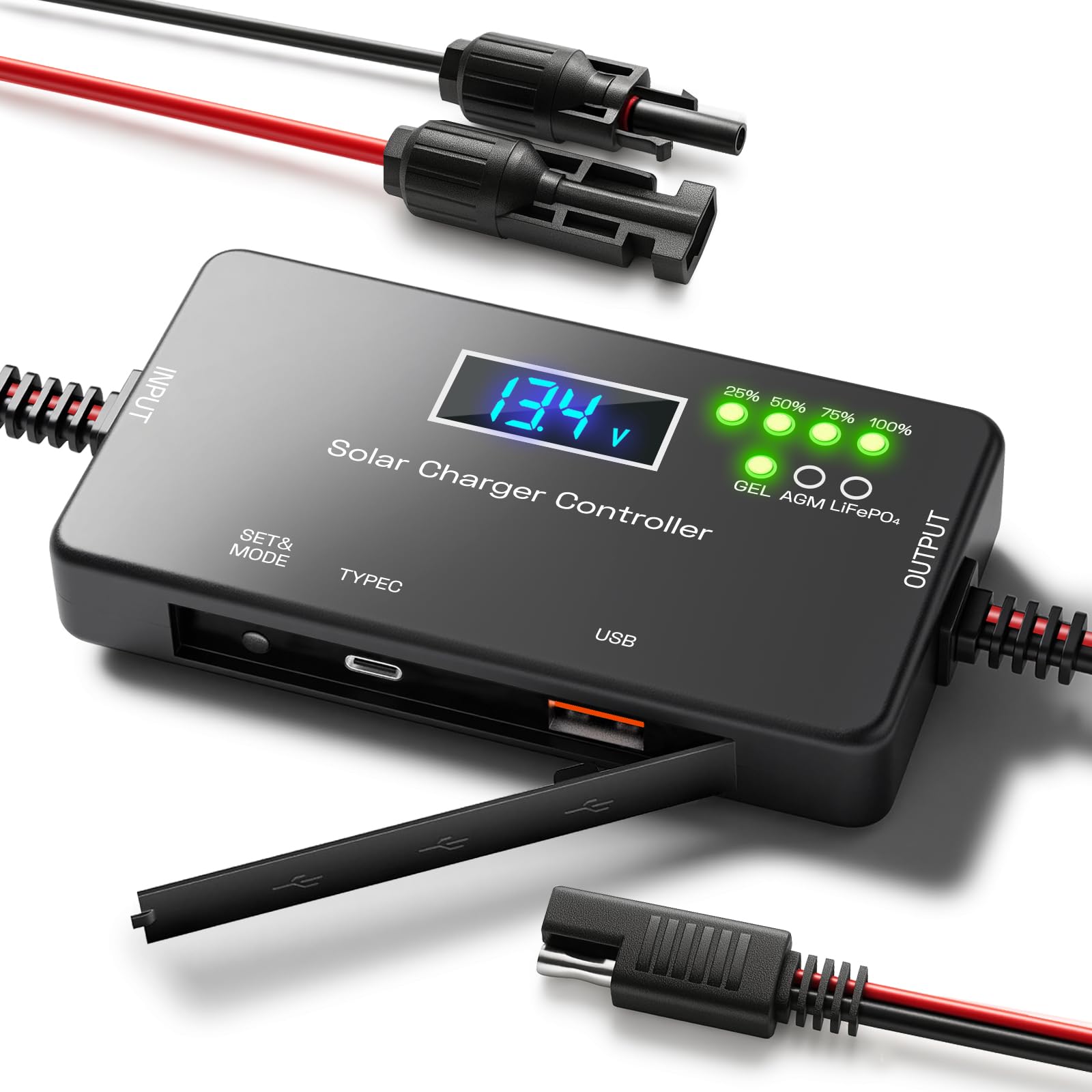
12V 20A PWM Solar Charge Controller with LCD for LiFePO4 AGM Gel Battery
Type: PWM
Max Charge Current: 20A
System Voltage: 12V
Battery Support: LiFePO4, AGM, Gel
Charging Ports: 22W Type-C, 18W USB
Display: LCD
Protection: Multi-protection circuitry
This is the budget unit that does two jobs. Beyond charging the battery, the 22W Type-C and 18W USB ports turn the controller into a charging station for a phone, a headlamp or a small fan, which is useful in a shed or a tent where there is no other outlet. The LCD shows the battery state at a glance, and the battery menu includes LiFePO4 alongside the lead-acid types.
It suits the buyer with a small panel, a single 12V battery and a handful of USB devices to keep alive. The trade-off is the PWM design and the modest 20A ceiling: a buyer with a larger array or a long cable run will get more from an MPPT unit, and the USB ports add convenience rather than harvest.
Before You Buy
- Type: MPPT tracks the panel’s peak power and harvests more from a small array; PWM is cheaper and fine for a panel whose voltage closely matches the battery.
- Current rating: Match the controller’s amp rating to the array’s short-circuit current with headroom to spare; an undersized unit clips harvest or trips protection.
- Battery compatibility: Confirm the controller lists the exact chemistry in use — flooded, AGM, gel or lithium — and whether lithium must be selected manually.
- PV voltage ceiling: The panel’s open-circuit voltage must stay under the controller’s input limit, especially when panels are wired in series on a cold morning.
- Location: An IP-rated, sealed housing suits exposed outdoor mounting; a vented indoor unit belongs in a dry enclosure.
- Cable and fusing: Size cable for the run length and fit a fuse between the battery and the controller; the controller protects the battery, not the wiring.
- Display and monitoring: A built-in LCD or Bluetooth app makes faults visible; a bare unit needs a separate meter to confirm the array is working.
Frequently Asked Questions
-
What size charge controller does a small solar array need? Size the controller to the array’s current with a margin above it, and keep the panel’s open-circuit voltage under the controller’s input limit. A 10A unit suits a single small panel, while 15A to 30A leaves room for a second panel.
-
Is MPPT worth it on a small array? MPPT earns its price when the panel voltage sits well above the battery voltage or when light is uneven. On a tiny array with a closely matched panel, a PWM unit can be the better value.
-
Can one controller handle lithium and lead-acid batteries? Many units list both, but lithium is often a manual selection rather than automatic detection. The battery chemistry must be set correctly before the first charge.
-
Does a waterproof controller need a dry enclosure? An IP67 unit can be mounted outdoors, but cable entries and connectors still need protection from standing water. A dry, shaded spot extends the life of any controller.
-
Why does the controller need a fuse? The controller regulates charging, but a short in the cable between battery and controller can carry high current. A fuse at the battery end protects the wiring and the unit.
-
Can a controller charge a phone directly? Only units with built-in USB or Type-C ports, and those ports are a convenience feature rather than a substitute for a proper battery bank.
Bottom Line
For most small arrays, the Victron Energy SmartSolar MPPT 75V, 15A is the pick that justifies its price: real MPPT harvest, a 75V input ceiling for a series-wired panel, UL1741 certification and Bluetooth monitoring in one compact case. Buyers on a tight budget or mounting outdoors should look at the SOLPERK for its IP67 housing, while the Renogy Wanderer covers a larger 12V bank at a mid-range price.
