Why there are Amazon links here: Brave Review is paid a commission for qualifying Amazon purchases made through the links below. Your price does not change, and using our links is entirely optional. How this works
Best Plug In Thermostat for a Rented Flat with Storage Heaters
A plug-in thermostat is the simplest way to get room-by-room temperature control in a rented flat without touching the wiring or asking a landlord for permission. It sits between the wall socket and the heater, switching the appliance on and off according to a set temperature, and it lifts out again at the end of the tenancy. The five picks below cover digital timers, universal dial units, remote-control models and a freeze-protection option, and each one suits a different kind of renter. The overview table gives the quick answer; the reviews that follow explain the trade-offs.
The Picks at a Glance
| Product | Key Spec | Best Use | Price Tier |
|---|---|---|---|
| Heavy Duty Digital Thermostat Outlet Plug | Digital countdown timer, wall-mount heater compatible | Renters who want timed heat runs | Budget |
| EconoHome Adjustable Thermostat | Universal plug-in, heating and cooling | EconoHome wall heater owners | Mid |
| Amaze-Heater Plug in Thermostat | Analog dial, heat and cool modes | Simple set-and-forget control | Mid |
| DIGITEN Wireless Thermostat Outlet | Remote control, power cord, 1800W | Reaching awkwardly placed heaters | Mid |
| HEATIT ET-21 Freeze Protection Thermostat Outlet | Fixed 38°F on / 50°F off, weather-resistant | Frost protection in cold rooms | Budget |
Heavy Duty Digital Thermostat Outlet Plug

Type: Digital thermostat outlet plug
Control: Countdown timer with adjustable thermostat
Compatibility: Wall-mount infrared space heaters
Build: Heavy-duty plug-in housing
Function: Temperature-controlled switching
This is the pick for a renter who wants heat delivered in defined blocks rather than left running all evening. The countdown timer is the headline feature: set a run time, and the unit drops the heater back to standby when the countdown ends, which suits storage heaters that only need topping up in short bursts. The digital thermostat adds adjustable temperature control on top, so the heater stops drawing power once the room reaches the target. The housing is built for the load of a wall-mounted infrared heater rather than a lamp or a phone charger.
It earns its place as the budget digital option, and it suits tenants with a fixed routine — a morning warm-up, an evening top-up — more than those who want heat on demand at random hours. The caution is the interface: a countdown-based unit asks the user to reset it each time, so anyone who wants the heater to look after itself overnight will find it fiddly. Buyers wanting unattended, always-on temperature regulation should look at the dial models instead.
Check the current price on Amazon
Trade-off: The countdown format needs manual resetting, which wears thin for anyone who wants set-and-forget heating.
EconoHome Adjustable Thermostat

Type: Universal plug-in thermostat
Modes: Heating and cooling
Compatibility: Most EconoHome wall-mount space heaters
Adjustability: User-adjustable temperature setting
Function: Temperature-controlled outlet switching
This unit is designed as the control partner for EconoHome wall-mounted panel heaters, and it works as a general plug-in thermostat for other appliances too. The adjustable dial sets the target temperature, and the outlet switches the heater on and off to hold it, which is exactly the behaviour a storage heater household wants in a room that overheats by evening. The heating-and-cooling modes mean the same plug can run a fan or a portable AC in summer, so it stays useful year-round. Build quality sits a step above the cheapest plugs, which is reflected in the price.
It suits the renter who already owns an EconoHome heater, or anyone who wants one plug to handle both seasons. The drawback is compatibility: the manufacturer positions it around its own heater range, so a buyer with a different brand should confirm the heater’s load and plug type before committing. It is also a fixed-location device — no remote — so it must be reachable to adjust.
Check the current price on Amazon
Trade-off: The strongest compatibility claims point at one heater brand, so other setups need checking first.
Amaze-Heater Plug in Thermostat

Type: Universal temperature-controlled outlet
Control: Analog dial
Modes: Heat and cool
Function: Energy-saving appliance switching
Compatibility: Heaters and air conditioners
The analog dial is the whole appeal here: no menus, no countdown to reset, just a rotary control that switches the connected heater on below the set point and off above it. That simplicity suits a shared flat or a household with mixed tech comfort, and it makes the unit easy to adjust by feel on a cold evening. Heat and cool modes let the same plug run a summer fan, and the energy-saving framing is honest — the outlet only powers the appliance while the room needs it. The housing is a compact single-socket design that fits standard wall outlets.
It suits renters who want unobtrusive, permanent-feeling control without an app or a remote. The trade-off is precision: an analog dial gives approximate settings rather than exact temperatures, so a buyer who wants to hold a room within a narrow band will find it coarse. There is also no timer, so scheduled warm-ups are not part of the package.
Check the current price on Amazon
Trade-off: Dial control is approximate and offers no scheduling, so precise or timed heating is out of reach.
DIGITEN Wireless Thermostat Outlet
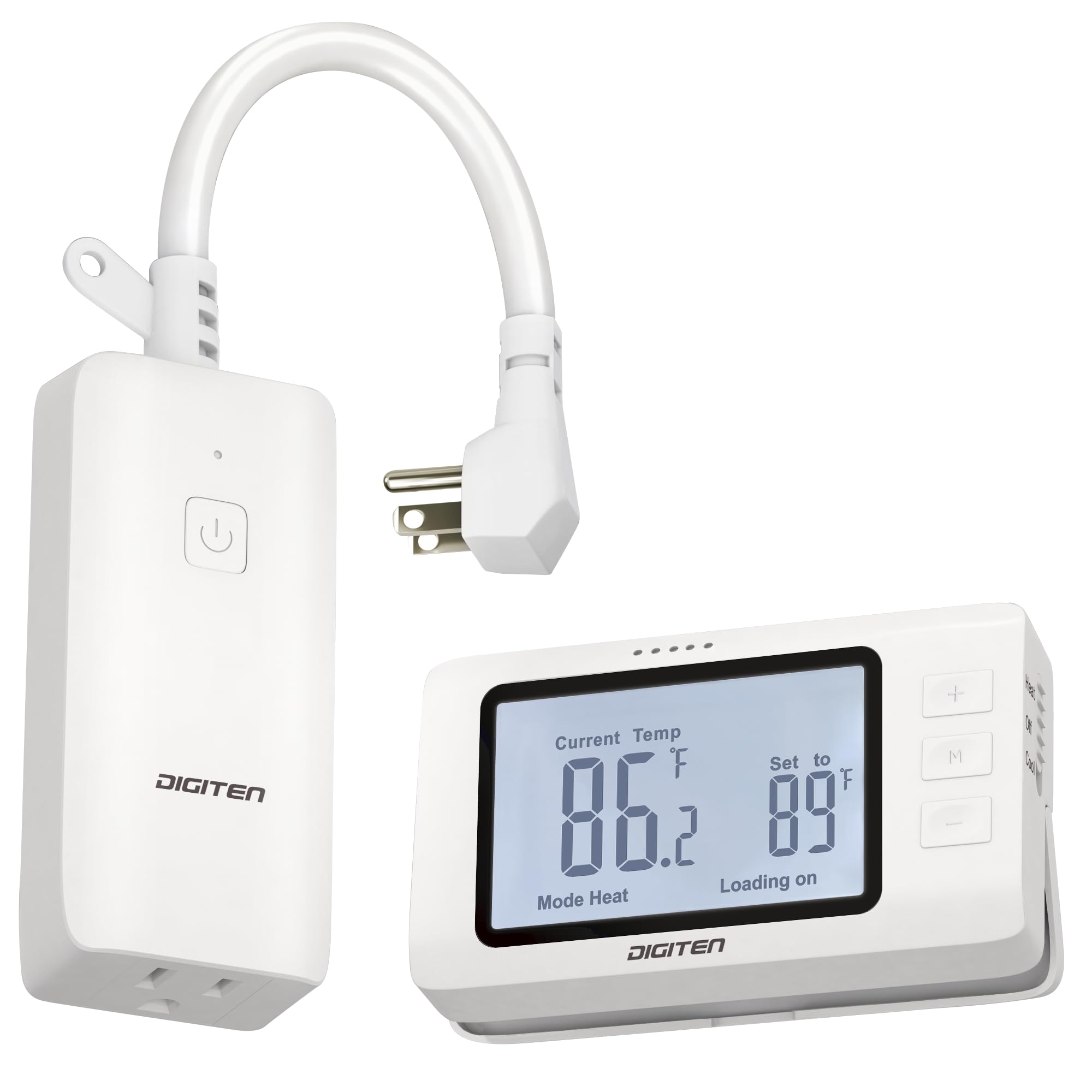
Type: Wireless thermostat outlet with power cord
Control: Remote control
Modes: Heating and cooling
Power handling: 1800W
Compatibility: Space heaters, fans, air conditioners
This is the pick for the flat where the heater sits behind furniture or high on a wall and the socket is a stretch to reach. The remote control handles temperature adjustment from across the room, and the power cord gives extra slack between the outlet and the unit, which helps in awkward corners. The 1800W rating is the figure to check against a space heater’s own label — most domestic plug-in heaters fall under it, but a large one may not. Heating and cooling modes carry it through the year.
It suits renters with limited mobility, tall wall heaters, or anyone tired of crouching behind a sofa to nudge a dial. The caution is the remote itself: a wireless handset is one more thing to lose or leave in the wrong room, and the outlet becomes hard to adjust without it. Buyers who prefer a control they cannot misplace should stick with a dial unit.
Check the current price on Amazon
Trade-off: Remote-dependent control means a lost handset leaves the outlet awkward to adjust.
HEATIT ET-21 Freeze Protection Thermostat Outlet

Type: Freeze protection thermostat outlet
Switching: 38°F on, 50°F off
Build: Grounded outlet, weather-resistant housing
Use: Indoor and outdoor
Application: Roof deicing and pipe heating cable
This is a single-purpose device: it powers up at 38°F and cuts out at 50°F, with no adjustment. That fixed band makes it a frost guard rather than a comfort thermostat, and it is the obvious choice for a renter’s cold spare room, a garage, or a pipe-heating cable that must not freeze. The grounded outlet and weather-resistant housing mean it can live outdoors or in a damp outbuilding, and the fixed thresholds remove any chance of misconfiguration. It is the cheapest and most widely bought unit on this list for exactly that reason.
It suits the renter who wants one job done — keeping a space above freezing — and does not need room-temperature control. The trade-off is the lack of adjustability: it cannot be tuned for comfort heating, so it is the wrong pick for a living room where the target is 68°F rather than 40°F. Buyers wanting general warmth should choose one of the adjustable models above.
Check the current price on Amazon
Trade-off: The fixed 38°F to 50°F band rules it out for comfort heating — it is a frost guard, not a room thermostat.
Before You Buy
- Load rating: Check the heater’s wattage against the thermostat’s rating before plugging in; an undersized plug is a safety risk, not just a performance one.
- Compatibility: Some units are built around one heater brand, so confirm the plug type and load of the existing heater first.
- Control type: Digital timers suit routine heating, dials suit simple always-on regulation, remotes suit hard-to-reach sockets, and fixed freeze guards suit cold rooms only.
- Landlord rules: A plug-in unit needs no wiring, but check the tenancy agreement for any clause on portable heating appliances.
- Placement: The thermostat measures the air around the plug, so avoid sockets in draughts, direct sun or behind furniture where readings will mislead.
- Storage heaters: These units switch a plugged-in appliance, so they suit convector or panel heaters on a plug; hard-wired storage heaters need a different approach.
Frequently Asked Questions
-
Will a plug-in thermostat work with a storage heater?
Only if the heater runs from a standard plug. Hard-wired storage heaters on off-peak circuits cannot be controlled this way, and the plug-in units here suit plug-in panel or convector heaters instead. -
Does a plug-in thermostat need an electrician?
No. It sits between the wall socket and the heater, so it can be fitted and removed by a tenant without any wiring work. -
Which pick is best for a renter on a tight budget?
The HEATIT ET-21 is the cheapest option, but it only guards against frost. For comfort heating on a budget, the Heavy Duty Digital unit offers the most control for the least money. -
Can one thermostat run both a heater and a fan?
The EconoHome and Amaze-Heater units both offer heat and cool modes, so the same plug can switch a summer fan or portable AC as well as a winter heater. -
Why does the thermostat reading differ from the room thermometer?
Plug-in units measure air at the socket, which can be warmer or cooler than the middle of the room. Moving the unit to a representative spot reduces the gap. -
Is a plug-in thermostat safe to leave running?
It is safe within its rated load and with a heater that is itself in good condition. The plug and socket should stay cool to the touch in use; anything else warrants switching off and checking.
Bottom Line
For most renters with plug-in heaters, the Heavy Duty Digital Thermostat Outlet Plug is the best plug in thermostat for a rented flat with storage heaters: it combines a countdown timer with adjustable temperature control at the lowest price of the digital options, and it lifts out at the end of the tenancy. Renters who already own an EconoHome heater should take that matching unit instead, and anyone who simply needs a cold room kept above freezing will find the HEATIT ET-21 does the job for less.
