Why there are Amazon links here: Brave Review is paid a commission for qualifying Amazon purchases made through the links below. Your price does not change, and using our links is entirely optional. How this works
Reolink 4K Solar Security Cameras Wireless Outdoor: 4G LTE Coverage Where Wi-Fi Fails
The Reolink 4K solar security camera is built for properties where a Wi-Fi signal never reaches the gate, the shed or the far fence line. It pairs a 4K sensor with a pan-tilt head, a spotlight for color night vision and a cellular radio that talks to the network directly instead of a router. This review covers its specifications, what each feature means in practice, and the trade-offs a buyer should weigh before ordering.
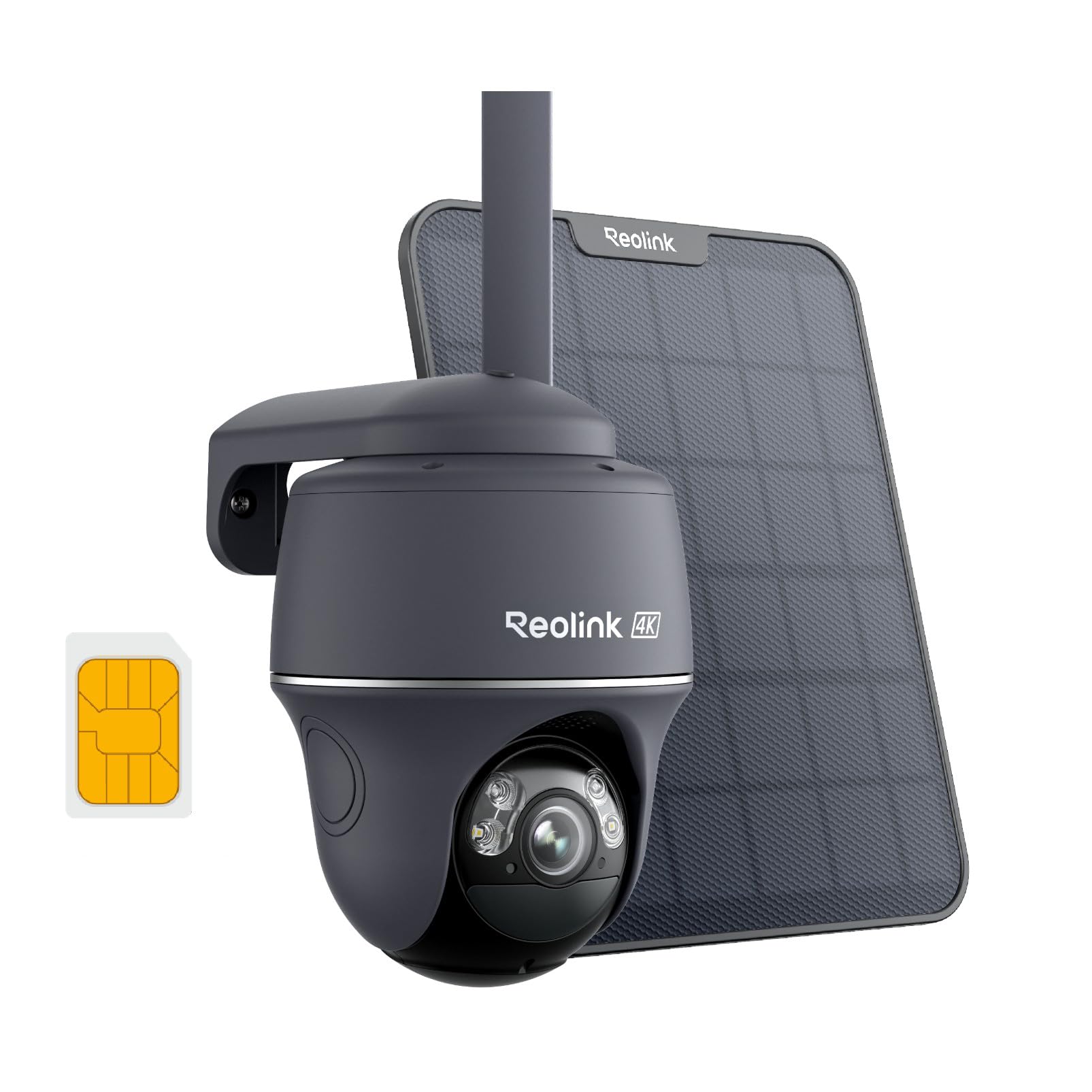
Features and Specifications
Type: Pan-tilt outdoor security camera with auto tracking
Resolution: 4K
Connectivity: 4G LTE cellular, no Wi-Fi required
Night Vision: Spotlight color night vision
Power: Solar
Storage: Local or optional cloud
Coverage: Pan-tilt with no blind spots claimed
Finish: Grey
Check current price and availability on Amazon
The headline here is the combination of cellular connectivity and a moving head. Most solar cameras on the market are fixed-lens units that rely on a home Wi-Fi network, which limits them to the reach of a router. This Reolink model removes both constraints at once: the 4G LTE radio handles the uplink and the pan-tilt mount handles the field of view.
That pairing is what justifies the price tier. A buyer is paying for coverage of a location that is both off-network and too large for a single fixed camera to watch.
Build and Design
The grey housing is meant for outdoor mounting, and the pan-tilt mechanism is the part that changes how the camera is used. A fixed camera watches one wedge of ground and leaves everything outside the lens unseen. A pan-tilt head sweeps across a much wider arc, which is why the product name claims no blind spots.
That claim deserves a plain reading. No single camera sees everything, but a moving head covers far more ground than a static one, and the auto-tracking function leans on that movement. When the camera detects something, the head follows it rather than letting it walk out of frame.
The trade-off with any moving mount is mechanical complexity. A pan-tilt camera has motors and a rotating joint that a fixed camera does not, so it is a more involved piece of hardware to install and to keep working over years of weather.
Power and Connectivity
Solar power is what makes the placement possible. There is no need to run a cable to a distant post or a gate pillar, because the panel tops up the battery during daylight and the camera runs off stored charge. The practical consequence is that buyers should think about sun exposure at the mounting spot before anything else.
The 4G LTE radio is the second half of that freedom. Cameras that need Wi-Fi are only as useful as the router’s reach, and a property with a detached garage or a long driveway usually has dead zones. A cellular camera sidesteps that entirely.
The caution is ongoing cost. A 4G camera depends on a data plan from a carrier, and that is a recurring bill a Wi-Fi camera never generates. The listing also notes local storage with optional cloud, so a buyer can keep footage on a card and skip a subscription, but the cellular service itself is a separate commitment to factor into the budget.
Image Quality and Night Vision
4K resolution is the top of the consumer range, and it matters most for identification rather than for watching. At distance, a higher-resolution sensor keeps faces and license plates legible where a lower-resolution camera would render them as smudges. That is the difference between footage that identifies someone and footage that merely shows something happened.
Spotlight color night vision is the second half of that. Infrared night vision produces black-and-white footage; a built-in spotlight illuminates the scene so the camera records in color after dark. Color helps with clothing and vehicle identification, which is often the detail that matters.
The honest caveat is that a spotlight is visible. A camera that lights up the area announces itself, which can deter an intruder but also tells anyone nearby exactly where the camera is pointed. Buyers who want quiet, unobtrusive monitoring should understand that trade before choosing this model.
Storage and Maintenance
Storage is flexible by design. Footage can be kept locally on a memory card, or pushed to the cloud as an optional extra. Local storage keeps the ongoing cost down and keeps recordings under the owner’s control; cloud storage adds remote access and off-site backup in exchange for a subscription.
Maintenance on a solar camera is mostly about the panel and the lens. Dust, pollen and snow on the solar panel reduce charging, and a dirty lens softens the 4K image. Both are quick wipe-down jobs, but they are recurring ones, and a camera mounted high on a wall is harder to reach than one at eye level.
Trade-off: The 4G radio requires a carrier data plan, so the camera carries an ongoing service cost that a Wi-Fi model does not, and the moving pan-tilt head adds mechanical parts that a fixed camera avoids.
Who It Suits and Who It Does Not
This camera suits rural and semi-rural properties, construction sites, farms, cabins and any location where the Wi-Fi signal stops well short of where the camera needs to go. It also suits buyers who want one camera to watch a wide area rather than several fixed units covering narrow slices.
It is not the right pick for a buyer with strong Wi-Fi coverage and a small yard. In that case a fixed Wi-Fi camera does the same job for less money and without a data plan, and the cellular radio is paying for capability that goes unused. Buyers who want zero recurring costs of any kind should also look elsewhere.
FAQ
-
Does the Reolink 4K solar security camera need Wi-Fi?
No. It connects over 4G LTE cellular, so it does not rely on a home Wi-Fi network. That is the main reason to choose it over a standard wireless camera. -
Does it need a SIM card and a data plan?
A cellular camera needs carrier service to send footage and alerts. Buyers should check which carriers cover the installation area and budget for an ongoing data plan alongside the hardware. -
How does the solar panel keep it running?
The solar panel charges the camera’s battery during daylight. Placement matters: a spot with direct sun for most of the day keeps the battery topped up, while heavy shade limits charging. -
What does auto tracking actually do?
When the camera detects motion, the pan-tilt head moves to follow the subject instead of letting it leave the frame. That is what lets one camera cover a wide area rather than a single fixed angle. -
Is 4K worth it over 1080p?
For identification at distance, yes. Higher resolution keeps faces and plates readable further out, which is usually the point of an outdoor camera. For close-range monitoring, the difference is smaller. -
Does spotlight color night vision stay on all night?
The spotlight activates to illuminate the scene when the camera needs it, rather than running continuously. That preserves battery and keeps the light from drawing constant attention. -
Can footage be stored without a subscription?
Yes. The camera supports local storage, so recordings can be kept on a memory card. Cloud storage is an optional add-on rather than a requirement. -
Will the spotlight give away the camera’s position?
Yes, when it activates. That can work as a deterrent, but buyers who want silent, unnoticed monitoring should weigh that against the benefit of color footage at night. -
Where should the camera be mounted?
Anywhere with a clear view of the target area and good sun exposure for the panel. The cellular connection removes the need for a cable run or a nearby router. -
Is a pan-tilt camera harder to maintain than a fixed one?
It has more moving parts, so the mechanism is one more thing that can wear over time. Regular cleaning of the panel and lens is the main routine task either way.
Bottom Line
The Reolink 4K solar security camera is the pick for a property that Wi-Fi cannot reach. Cellular connectivity, solar power and a pan-tilt head with auto tracking together cover ground that a fixed Wi-Fi camera simply cannot, and the 4K sensor with spotlight color night vision gives that coverage identification-grade detail. Buyers with solid Wi-Fi and a small yard will pay for capability they do not need, but for a gate, a field or a remote building, this is the model that fits the job.
